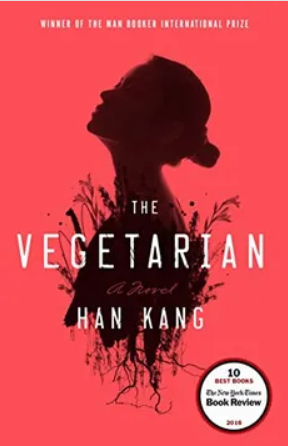
Some books don’t just tell a story — they stay with you. The Vegetarian by Han Kang is one of those unsettling, powerful novels that quietly question freedom, identity, and the limits of the human mind. In this review, I share what this book made me feel, what I admired, and where it deeply challenged me as a reader.
Review: The Vegetarian — Han Kang (2024 Nobel Prize in Literature)
The Vegetarian is a novel divided into three chapters that narrate, in a linear way, the story of Yeonghye. It begins with the day she decides to stop eating meat and explores how her life evolves after making this choice.
The story is told from the perspectives of external characters, and Yeonghye’s voice is heard only through sparse dialogue, never directly.
The connection between the chapters develops gradually, allowing the narrative to unfold slowly and deliberately. In the first chapter, Yeonghye is portrayed through the eyes of her husband, an indifferent, opportunistic, and violent man who focuses entirely on how his wife’s decision to stop eating meat disrupts his life. The second chapter, written in the third person from the perspective of her brother-in-law, raises questions about his true intentions—whether he genuinely wants to help or simply seeks to understand Yeonghye and her situation. Without revealing too much of the plot, many readers will likely anticipate the answer. Finally, the third chapter, also written in the third person, is narrated from her sister’s perspective. Although her sister genuinely loves her, she is unable to understand her or find a way to help. For Yeonghye, it is already too late.
Personal Reflection and Themes
Overall, reading this novel was both shocking and heartbreaking. The first chapter, narrated in the first person by her husband but written by a woman, made me question whether the perspective truly reflects that of a man who can describe himself so self-critically. It’s hard to believe he would consciously recognize his faults and motivations to such a degree.
Throughout the novel, Yeonghye is subjected to various forms of violence by those around her. Moreover, this violence is not only physical but also emotional and psychological. The story delves far deeper than her decision to stop eating meat. With no one around her willing or able to understand her, Yeonghye endures a chain of abuse, even from those who claim to want to “save” her. The only thing Yeonghye seems to truly control is what she refuses to eat. No one can force her to eat, just as no one can force her to speak, think, or feel.
The Silence of Yeonghye
In my view, she was never truly given a voice; in fact, the novel doesn’t grant her one either. Her thoughts and emotions are glimpsed only through a few fragments of dialogue that, as she herself notes, no one seems to understand. Not even I, as a reader, can fully comprehend her. What the story leaves me with is the sense that, amid so much pain and indifference, Yeonghye chose to lose herself and disconnect from the world voluntarily.
In the end, interpreting the protagonist’s behavior becomes extremely difficult because, without hearing her directly, everyone perceives her from their own perspective. This is why the book lingers in your mind, leaving the reader trying to find an explanation or an answer that, unfortunately, will never come. However, it allows us to understand the viewpoints of other readers, making it an interesting book for discussion.
This novel is one I would recommend to readers who seek complex and psychologically intense stories and are comfortable exploring themes of control, identity, and silent resistance to violence.
About the Author of The Vegetarian
Han Kang, the author of The Vegetarian, was awarded the 2024 Nobel Prize in Literature “for her intense poetic prose that confronts historical trauma and exposes the fragility of human life.” first published in 2007, later translated into English in 2015, and winner of the 2016 Man Booker International Prize. Han Kang’s other works translated into English include Human Acts, The White Book, Europa, and The Greek Lessons.
If you enjoy reflective literary journeys like this one, I invite you to explore the Nobel Prize in Literature Authors page as well as the main space of My Journey into Reading, where I share book reviews and personal reading experiences — stories that have stayed with me long after the final page.


Leave a Reply