
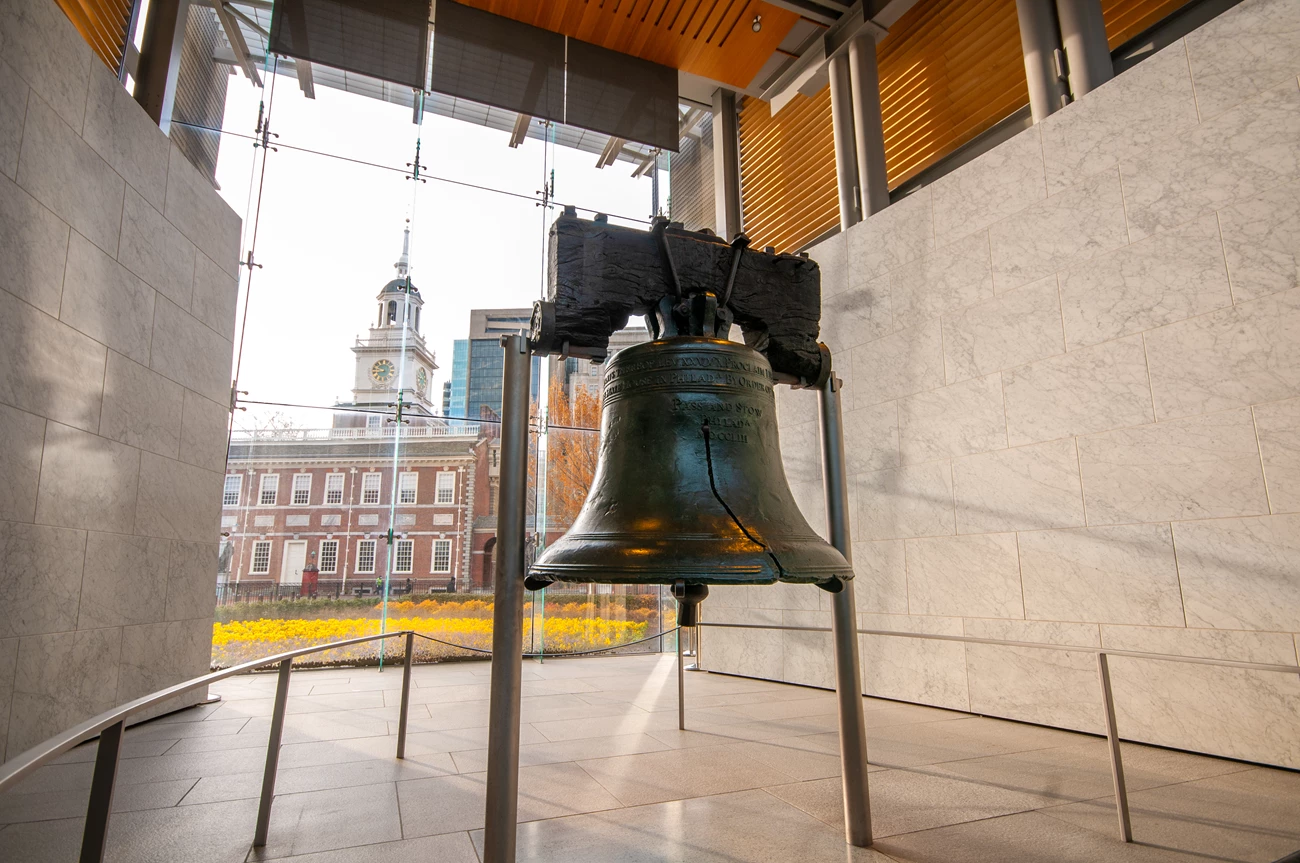
Finally, in this journey, we arrive at the Liberty Bell. I’ve been to Philadelphia twice. The first time was in the summer, and it was impossible to see the bell up close — admission is free, but the line was endless. When I went back in winter, it was a completely different experience. There was no line, and the visit was peaceful. Security is similar to that of an airport: you must place your belongings in a tray and go through a scanner. And then, right in front of me, stood the famous bell — a symbol of patriotism for the entire United States.
But how did a bell, cracked from its very first use, become such a powerful symbol? Let me try to tell you.

A Symbol of Freedom with an Unexpected Beginning
The Liberty Bell, located in the Liberty Bell Center across from Independence Hall in Philadelphia, Pennsylvania, was commissioned in 1751 by the Pennsylvania Assembly to commemorate the 50th anniversary of the 1701 Charter of Privileges, which guaranteed certain political and religious freedoms to the colony’s residents.
The bell was cast in London by the Whitechapel Bell Foundry and shipped to Philadelphia in 1752. However, during its very first test ring, it cracked. Two local founders, John Pass and John Stow, recast it using the original metal — that’s why their names appear inscribed on its surface.
Around the top of the bell is a verse from the Bible (Leviticus 25:10):
“Proclaim LIBERTY Throughout all the Land unto all the Inhabitants Thereof.”
For many years, the bell was used to call citizens to meetings and to announce significant events, though there is no definitive evidence that it rang on July 4, 1776, when the Declaration of Independence was adopted.
Over time, however, the Liberty Bell came to represent something much greater. In the 19th century, abolitionists adopted it as a symbol of the fight against slavery, and its message of freedom and equality began to resonate across generations.
The bell’s distinctive crack was not the result of one single incident, but rather of several failed attempts to repair earlier fractures. Eventually, it was decided never to ring it again, preserving it in its current state — imperfect, yet profoundly meaningful.
Bibliography
- National Park Service. The Liberty Bell. https://www.nps.gov/inde/learn/historyculture/stories-libertybell.htm
- Independence Hall Association. Liberty Bell Facts & History. https://www.ushistory.org/libertybell/
- Encyclopedia Britannica. Liberty Bell. https://www.britannica.com/topic/Liberty-Bell
Reasons to Visit the Liberty Bell
- Free and accessible: Admission to the Liberty Bell Center is free and open most of the year.
- Surrounded by history: Located right across from Independence Hall, where the Declaration of Independence was debated and signed.
- A timeless message: The bell represents liberty, equality, and resilience in the face of adversity.
- Educational and inspiring: Exhibits, videos, and interpretive panels tell the story of its role in American history and social movements.
- A photo worth keeping: The view of the bell with Independence Hall in the background is one of Philadelphia’s most iconic sights.



Leave a Reply